
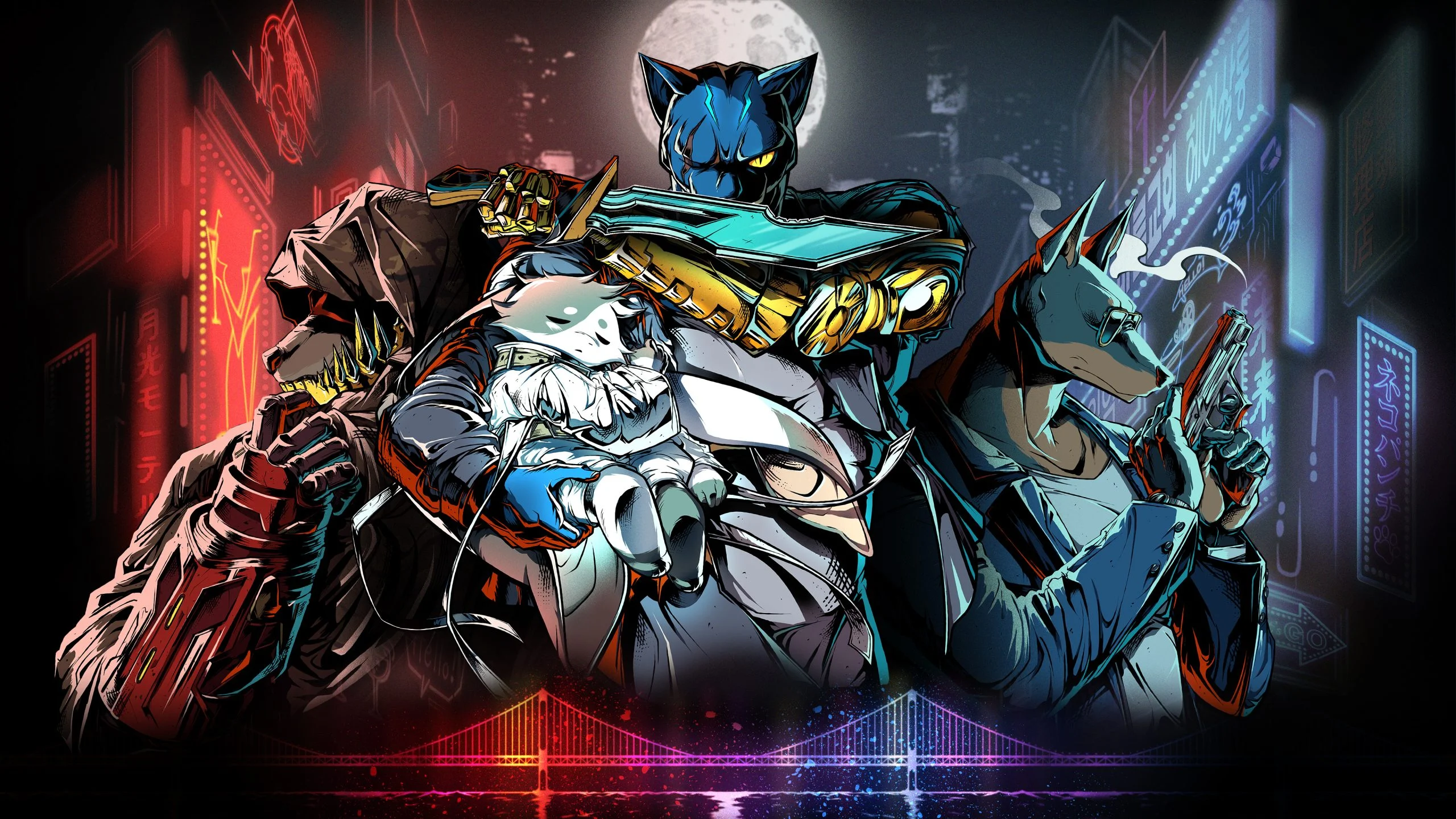
Kusan adds expressive buildcraft and tactical options to the one-hit-kill formula. Larger stages, unreliable targeting, and a costly retry loop repeatedly interrupt the rhythm those additions should support.
MORE CONTROL, A HIGHER RETRY TAX
Kusan: City of Wolves is much more than another Hotline Miami clone. Its additions are often smart, but they sometimes undermine the effortless rhythm that makes its inspiration such a classic.
Hotline Miami makes trial and error work by keeping failure cheap. Kusan gives you more control over your approach while repeatedly making the cost of a failed attempt too high.
There are meaningful mechanical improvements here. The problem is how they interact with the size of the levels and the demands of the retry loop.
A MORE DELIBERATE TOOLKIT
Kusan keeps the frantic one-hit-kill foundation, but replaces much of Hotline Miami’s scavenged improvisation with a preselected toolkit.
A robotic arm gives you a reliable one-hit melee attack. A recoverable throwing knife provides a consistent ranged option. Assorted firearms can be unlocked and equipped, but you do not take new weapons from enemies during a level.
What you bring is what you have. That creates a more tactical identity, although improvisation feels less inspired.
The freedom also limits how precisely a level can be built around your tools. The designer cannot assume which firearm or perks you will bring.
BUILDCRAFT IS THE REAL EVOLUTION
A grid-and-block system lets you construct substantially different versions of Jin. Upgrades occupy differently shaped blocks, creating a Tetris-like exercise in fitting the build together.
Space is limited, expanding the grid costs resources, and every inclusion has an opportunity cost. Firearms occupy space too, and you can bring only one.
The perks can change how you approach a stage, and upgrading them gives a satisfying progression curve. Bonus rewards sometimes encourage particular weapons, but levels still have to accommodate many different combinations.
That tradeoff matters. Greater build freedom produces less tightly controlled combat puzzles.
Most games inspired by Hotline Miami copy its violence and difficulty. Kusan recognizes that the formula can also support meaningful expression through more than mechanical execution.
INTERESTING LEVEL IDEAS, COSTLY EXECUTION
The levels include alternate routes, secret areas, exploration rewards, and optional execution challenges. Timing puzzles are a particularly good addition.
On paper, these are more interesting spaces than isolated combat gauntlets. In practice, connecting multiple rooms and floors creates trouble for a game built around frequent death.
In Hotline Miami, mastering a short section makes it quick to repeat. Kusan can require clearing three or four connected sections again after a mistake.
Some entrances put you under fire immediately. Descending a ladder blind can leave almost no time to read the room before you must act. There is no look-ahead mechanic to scout beyond the current screen.
I did not encounter cheap offscreen kills, but learning what lies ahead can still require risking death. That is tolerable when the known part takes 15 seconds to repeat. It becomes exhausting when a large stage sends you through several already-solved sections.
The freedom to experiment is valuable. The growing cost of an imperfect strategy discourages using it.
THE LOCK-ON CAN BREAK THE FLOW
The lock-on system makes shots reliable and turns the throwing knife into an easy kill. When several enemies are close together, it can also target the wrong threat at exactly the wrong moment.
A common problem is wanting to shoot a ranged enemy and punch a nearby melee enemy, only for the lock-on to select the melee target. Then you get shot and replay the stage.
Having to fight the targeting system repeatedly disrupts momentum. Free aiming in Hotline Miami felt more functional for this kind of combat.
Corner kiting and spamming the pistol became especially effective ways to avoid those issues. When targeting works, Kusan can feel every bit as good as its inspiration. When it fails, the flow stops abruptly.
THE SOUNDTRACK DOES NOT CREATE THE SAME RHYTHM
Hotline Miami’s musical choices get under your skin. Some of those tracks remain burned into my memory and on my playlists.
Kusan’s music is not bad. It simply feels less additive. It does not consistently match the pace, aesthetic, or tone closely enough to pull me into the same flow state.
This genre needs more than unobtrusive background music. Sound helps regulate the pace and emotional rhythm of repeated attempts.
Mechanically, Kusan sometimes matches or surpasses Hotline Miami. Atmospherically, it never came close for me, nor did its soundtrack reach the standard of Katana Zero.
A stronger musical identity might have helped carry me through the other frustrations. Instead, the combat has plenty of energy without an equally compelling emotional rhythm.
THE ART DIRECTION CREATES A TASTE BARRIER
Yes, I am a video-game-playing frog. No, I am not a furry. That distinction matters to how this particular art direction landed for me.
The character art is not simply cartoon animals in the broadly accessible style of Star Fox. Its visual language is explicitly fursona-like, with several designs feeling uncomfortably adjacent to DeviantArt furry erotica.
I am usually unbothered by anthropomorphic characters or erotica-adjacent games. Here, the specific presentation repeatedly pulled my attention away from the drama.
If that aesthetic appeals to you, this may be a strength rather than an obstacle. For me, it created a substantial barrier to immersion.
METAL GEAR INFLUENCE, LESS INTRIGUE
The story has an interesting premise and obvious Metal Gear Solid influences: government conspiracies, psychic soldiers, and a leader commanding soldiers abandoned by their country.
The gang’s name, Diamond Fox, practically announces the mixture of Diamond Dogs, FOXHOUND, and Big Boss.
Jin is haunted by his military past and the loss of the woman he loved, who served as a psychic soldier. Protecting a psychic child clone of that woman immediately pulls on that history.
The espionage-thriller side often gives way to melodrama. The plot remained interesting enough to follow, but it could not overcome the art-direction barrier for me.
VERDICT
Kusan is ambitious and establishes a real identity through excellent buildcraft, expressive combat, alternate routes, and optional challenges.
Its additions also work against its foundations. Larger stages raise the cost of failure, limited scouting makes experimentation risky, and awkward lock-on repeatedly interrupts momentum.
The soundtrack does not provide the hypnotic cohesion of its inspiration, and the art direction creates a significant personal taste barrier.
This is a good game I respect more than I ultimately enjoyed. It has more depth than a straightforward clone, but less of the rhythm that makes this formula so satisfying.
8/10
Reviewed by VG Frogman
Platform: PC
Publication date: 10/10/2026