
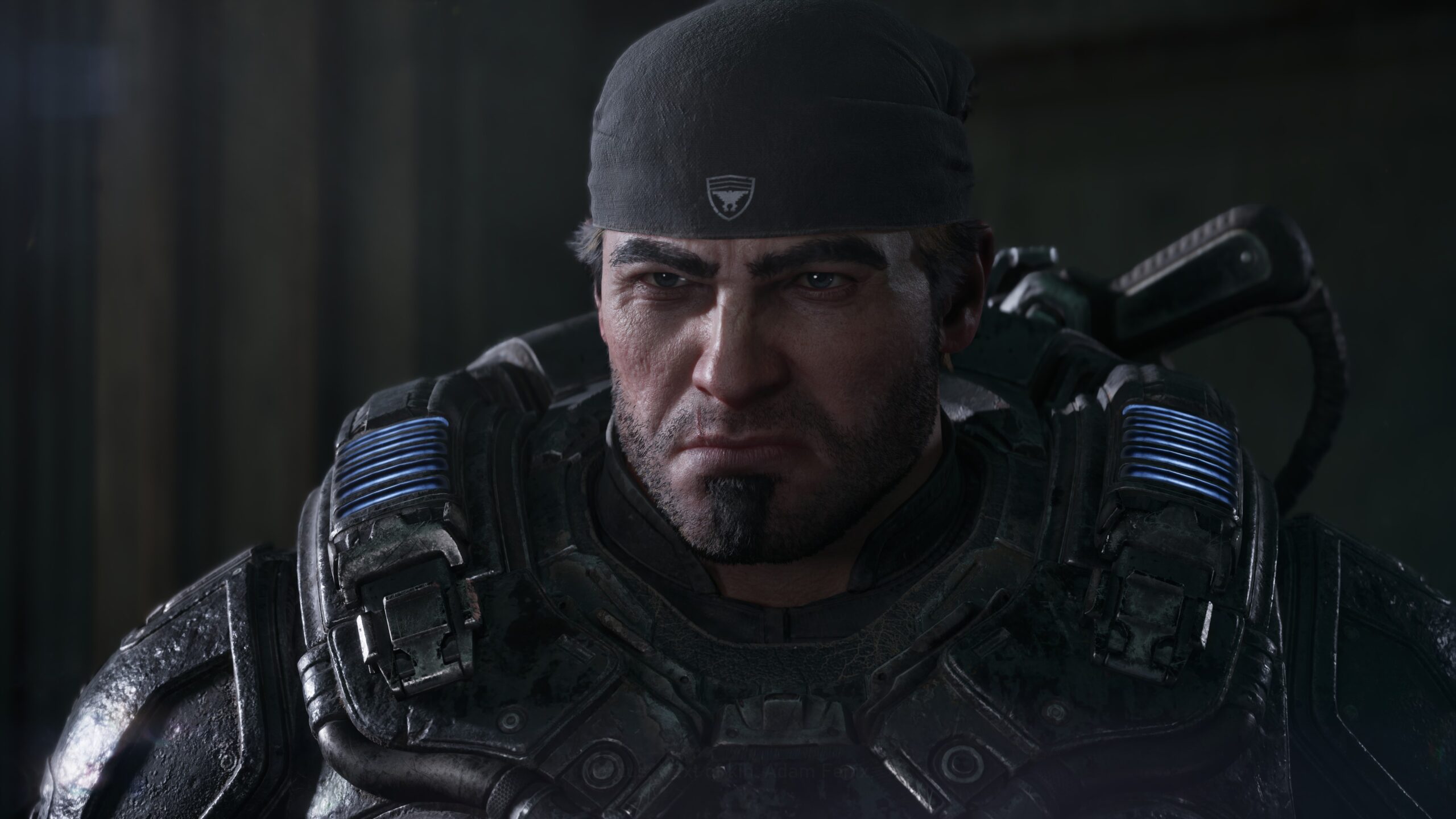
Gears of War: E-Day modernizes the series with faster, more aggressive movement, only to repeatedly drag the player back into the static cover attrition its new mechanics seem designed to escape.
E-DAY ACTUALLY FEELS LIKE THE END OF THE WORLD
Gears of War: E-Day succeeds immediately at something the premise absolutely requires: Emergence Day feels catastrophic.
The Locust invasion does not feel like another war humanity happens to be fighting. Civilians and soldiers are torn apart, entire sections of Kalona collapse around you, and almost everyone seems completely unprepared for what is happening. Especially during the first half of the campaign, there is a genuine sense that humanity is losing and knows it is losing.
The visual presentation does a tremendous amount of work here. E-Day is gorgeous, and on my PC I was generally able to maintain 60 FPS at 4K Ultra using FSR 4 Quality, although some later areas dipped into the 40s. The campaign took me roughly 13 hours to finish.
The narrative is strong throughout most of that runtime. Marcus and the supporting cast are compelling, and several emotional moments land extremely well.
Comparisons to Halo: Reach are inevitable, and appropriate. Both games revolve around characters fighting through a catastrophe whose eventual outcome the audience already knows. E-Day does not sustain that feeling of inevitable collapse quite as consistently as Reach, and its ending is considerably weaker, but at its best it captures a similar sense of desperation.
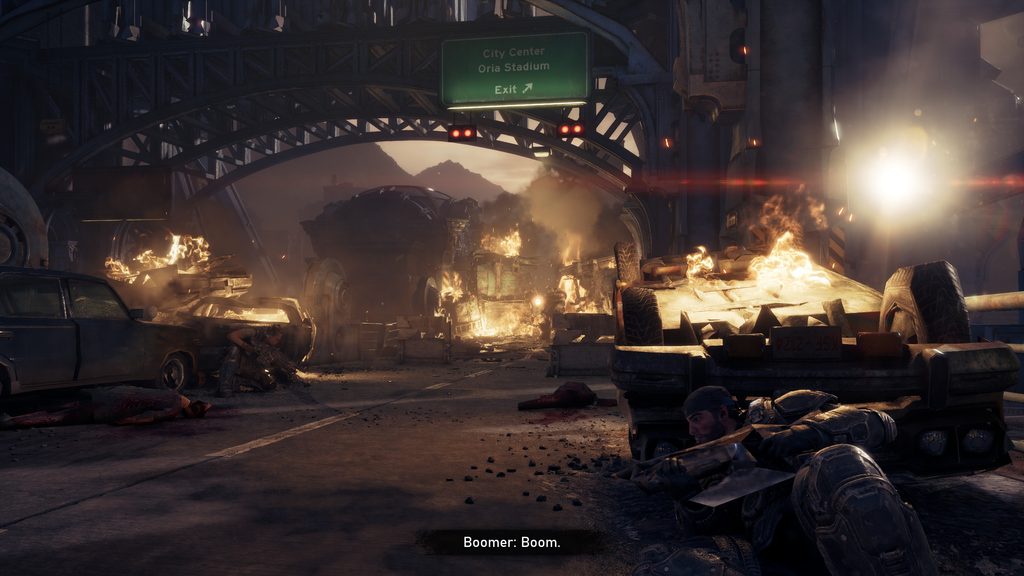
GEARS IS BEST WHEN IT GETS OFF THE WALL
I am not a massive Gears veteran. Before E-Day, my experience with the series consisted primarily of the remaster of the original game and Gears 5. From that perspective, E-Day still unmistakably feels like Gears of War: obvious combat arenas, chest-high cover, the Gnasher, and the familiar rhythm of pushing forward through combat encounters between narrative beats.
That is not a criticism. E-Day does not need to reinvent the third-person shooter to be excellent.
The important evolution is mobility.
Marcus is considerably more athletic than before. Faster sprinting, vaulting and sliding make aggressive positioning substantially more viable. Closing distance with the Gnasher feels fantastic. Instead of anchoring yourself to one wall and methodically firing from cover, the best encounters encourage you to constantly reposition, push enemies and transition between traditional cover shooting and close-quarters aggression.
When the game gives you room to play this way, Gears feels better than ever.
The problem is that the movement has evolved faster than some of the encounter design. Gears E Day
THE HEAVIES PULL E-DAY BACKWARD
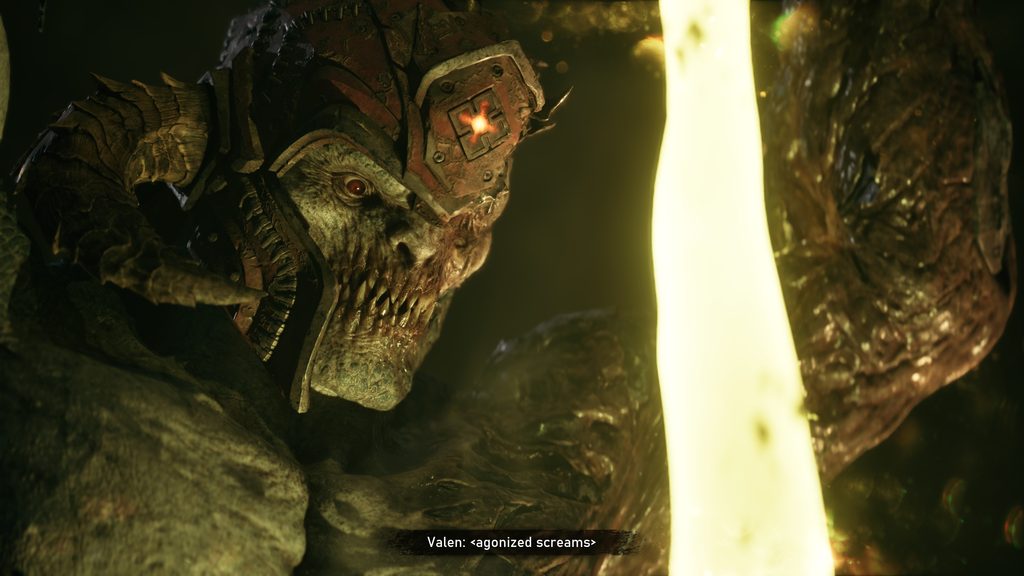
As the campaign progresses, E-Day increasingly fills encounters with Boomers, Flayers, Grinders and other high-health enemies, frequently throwing several types into the same fight.
None of these enemies are inherently bad. The problem is frequency.
Heavy enemies absorb huge amounts of damage, knock Marcus down easily and exert enough pressure that aggressive movement often becomes the wrong answer. The optimal strategy increasingly becomes staying behind cover and dumping ammunition into large targets until the game finally allows you to move around freely again.
That creates a bizarre contradiction.
The game gives Marcus the tools to escape static cover-shooter combat and then repeatedly creates encounters that punish him for using them. One fight feels like a genuinely modern evolution of Gears. The next throws enough durable enemies onto the field that you are effectively back to slow attrition warfare.
It makes the combat feel mechanically schizophrenic.
I originally suspected four-player co-op was part of the explanation. AI squadmates are serviceable, but they do not create the same threat or damage output that human players would. Playing solo frequently funnels the majority of enemy pressure toward Marcus, making encounters that may have been designed around coordinated target selection feel like wars of attrition. I cannot know whether that was the actual balancing intent, but there are absolutely moments where it feels like you are playing a four-player encounter by yourself.
There may also be another factor: supply caches.
Because power weapons can be replenished so consistently, the campaign can afford to assume players have near-constant access to extremely high-damage tools. That helps make sense of the heavy-enemy density—but it introduces another problem. If repeated Boomers and Grinders are effectively balanced around the player carrying a Longshot, Torque Bow, Gut Puncher or another high-output weapon, much of the ordinary arsenal becomes structurally secondary.
The sandbox may contain plenty of weapons, but if competent play increasingly resolves into keep a power weapon stocked because the next group of heavies is coming, the practical decision space is much smaller than it appears.
I don’t want the answer to every difficult encounter to be spam the Torque Bow because the game gives me infinite Torque Bow ammunition.
That solves the encounter numerically. It does not make the combat more interesting.
THE FINAL BOSS IS THE WORST VERSION OF THE PROBLEM
The final boss takes nearly everything frustrating about the late-game encounter design and concentrates it into one fight.
Without spoiling the encounter itself, it combines an extremely durable target with heavy area denial, punishing attacks and lethal environmental hazards. Losing maneuvering space can quickly result in Marcus being repeatedly knocked down while the AI squad collapses around him, forcing another restart.
It should have been the ultimate showcase for E-Day’s new mobility.
Instead it emphasizes attrition, kiting and restricted movement.
That’s a terrible way to conclude a combat system whose best innovation is giving the player greater freedom to move.
THE OPEN CITY WORKS BETTER THAN I EXPECTED
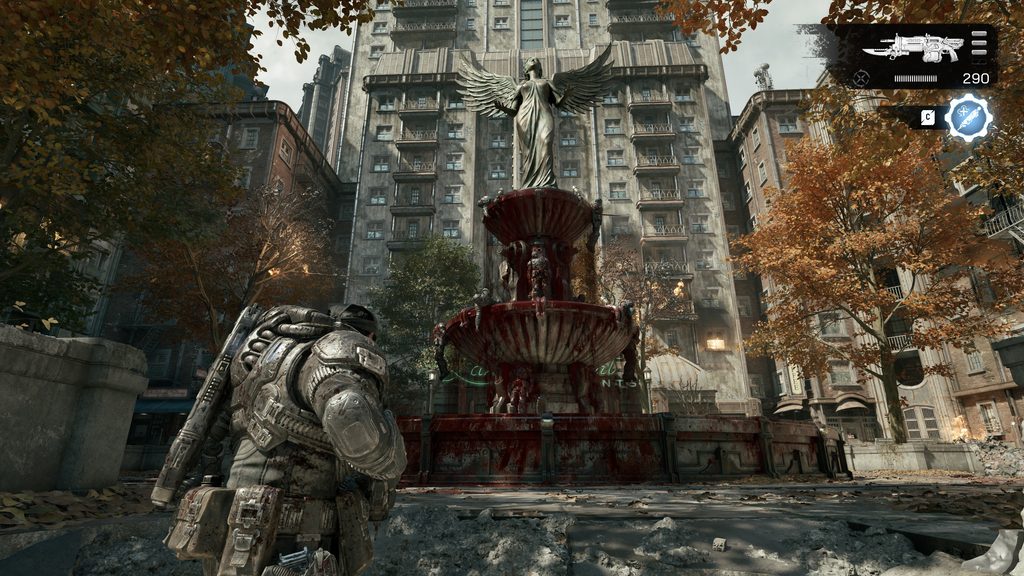
The open-city sections have received criticism, but I actually think they work reasonably well.
They are significantly smaller than Gears 5’s open zones, which I prefer. Traveling through Kalona and deciding which side objectives to pursue gives the city a stronger sense of place. You are participating in the catastrophe rather than simply traveling through a sequence of disconnected combat arenas.
There is some unavoidable narrative dissonance. Humanity is experiencing an extinction-level invasion while Marcus occasionally decides that now would be a good time to handle a side objective.
But the content is optional, and even the exploration generally reinforces the larger catastrophe. Players who only want the main campaign can largely ignore it.
The late-game encounter design hurts E-Day’s pacing considerably more than the open city does.
MODS HAVE MORE PERCEIVED DEPTH THAN RESOLVED DEPTH
Weapon and armor mods never became as interesting as they initially appeared.
Exploration and side content provide new mods and additional slots, seemingly creating a system where players can specialize weapons, experiment with builds and adapt their equipment to different combat situations.
In practice, I found a setup I liked relatively early and never encountered a compelling reason to abandon it.
The system has considerably more perceived depth than resolved depth.
Different combinations undoubtedly work, and players who inherently enjoy experimentation can probably get substantially more out of the system. But the campaign never meaningfully required me to engage with that experimentation. My preferred setup continued solving the problems the game presented.
The hard-case reward structure compounds the problem. You never know whether exploration will reward you with an upgrade supporting your preferred equipment or something completely irrelevant to your build. Eventually exploration can start feeling like opening loot boxes until the game happens to produce something useful.
For me, that had the opposite of the intended effect: once my build worked, randomized rewards made me less interested in exploring.
A progression system closer to Resident Evil, where resources can be deliberately invested into upgrades the player actually wants, would have been substantially more satisfying.
VERDICT
Gears of War: E-Day succeeds at making Emergence Day feel like the horrific cataclysm it is supposed to be. Its presentation is excellent, its narrative is strong, and the atmosphere is among the best depictions of an apocalypse I have seen in a shooter.
Its increased mobility is also a genuine mechanical evolution for the series.
That’s what makes the encounter design so frustrating.
E-Day is at its best when it lets Marcus get off the wall—vaulting over cover, sliding across battlefields and aggressively pushing with the Gnasher while Kalona collapses around him. The later campaign repeatedly introduces enemies and encounter compositions that force everything back toward the same slow cover attrition the movement system seemed designed to escape.
It does not ruin the game.
E-Day is still very good.
But with encounter design that consistently supported its best new mechanic, it could have been exceptional.
8/10
Reviewed by VG Frogman
Platform: PC
Published: 10/07/2026