
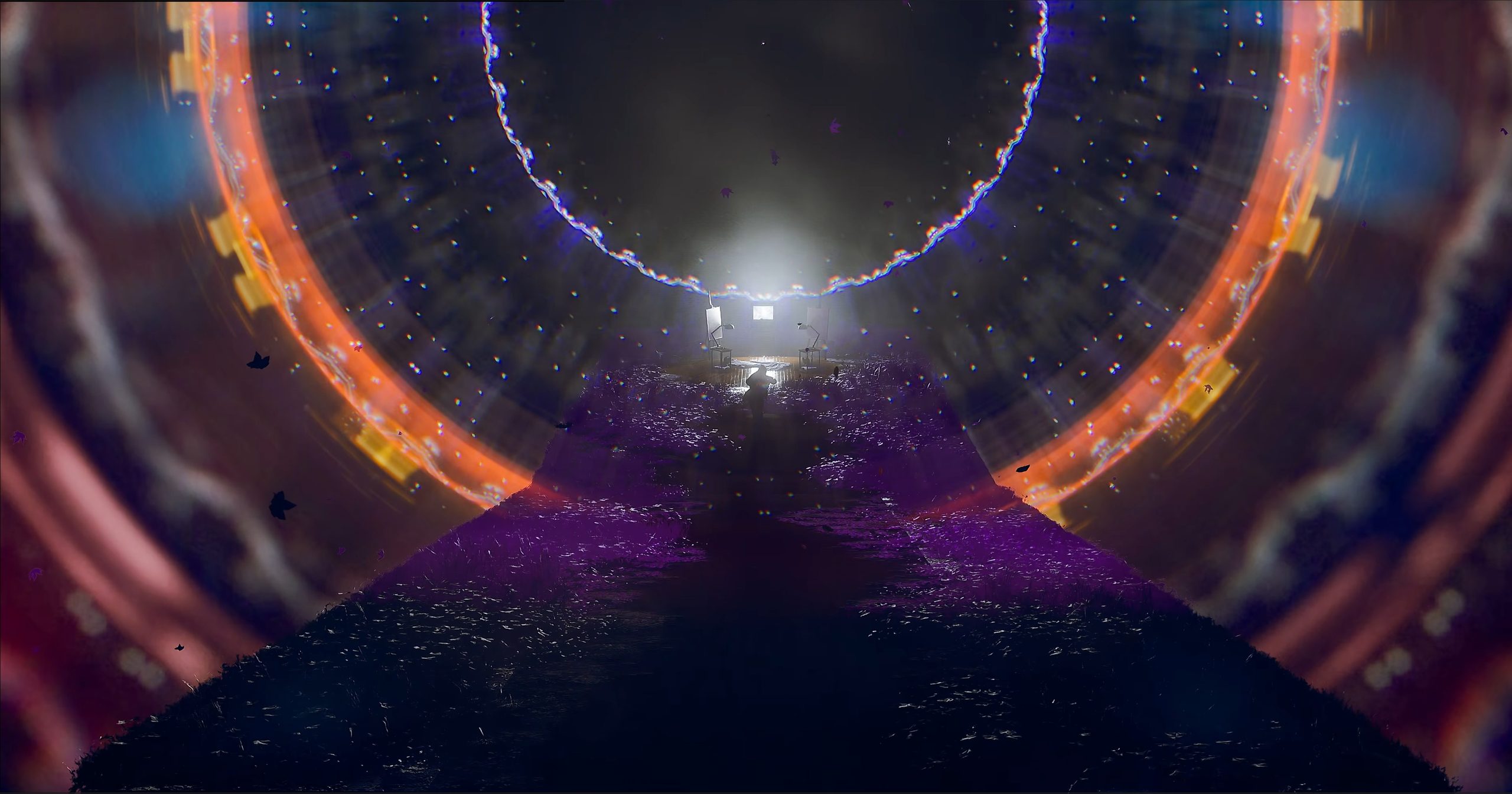
Control Resonant is a masterpiece of cohesive game design because almost nothing exists in isolation. Narrative, level design, exploration, combat, progression, and presentation constantly reinforce one another.
REVIEW
I usually finish games with pages of notes. Systems that fight against each other. Mechanics that never realize their potential. Pacing problems, unnecessary friction, wasted ideas—something I can pull apart and figure out why it does or does not work.
I barely had notes for Control Resonant.
That is not because the game lacks complexity. It is because almost everything it does just fucking works.
The brilliance of Resonant is not that every individual component is excellent in isolation. What elevates it into masterpiece territory is that almost nothing exists independently of anything else. Its reality-warping narrative justifies impossible architecture. That architecture gives purpose to traversal abilities. Traversal changes how the world can be explored. Exploration creates unusual combat spaces. Combat abilities interact with those spaces. Exploring reveals more of the world and its fiction, while the art direction, animation, sound design, and performances make that impossible world convincing enough to inhabit.
THE FLOOR DOESN’T HAVE TO BE THE FLOOR
The clearest example is Shift.
At first, Shift feels like an unusually cool traversal mechanic. Change your orientation, walk up a wall, reach a new platform. Maybe you find a shortcut or gain access to somewhere that was previously unreachable. It is clever, but initially understandable within the language games have already taught us.
Then Resonant starts removing that language.
As the game progresses, the environments become increasingly dependent on your ability to navigate space in 360 degrees. Walls, floors, and ceilings stop functioning as permanent categories. The floor can become the wall. The wall can become the ceiling. “Down” stops being a universal direction and becomes relative to however you are currently oriented.
Traditional level design benefits enormously from one basic assumption: down is down.
Control Resonant throws that assumption in the trash.
A wall is no longer necessarily a boundary. Verticality is no longer simply a matter of looking upward. Spaces can be constructed around several valid orientations simultaneously, forcing you to rebuild your mental model of an environment while you are moving through it.
Shift therefore stops being a traversal gimmick and becomes something much more important: it changes what a level is even allowed to be.
And crucially, the fiction permits all of this insanity. The architecture is not bending itself into impossible shapes because the designers wanted a cool puzzle room. Reality itself is unstable. The mechanics, level design, and narrative all agree that these spaces should behave this way.
MANHATTAN ISN’T REALLY AN OPEN WORLD
Moving the sequel out of the Oldest House and into Manhattan necessarily changes some of the mystery that defined the first Control. A city is inherently more familiar than an unknowable brutalist building that seems actively hostile toward conventional geometry.
The tradeoff is worth it.
Resonant gains considerably more environmental variety, and—more importantly—the larger spaces give its traversal systems room to breathe without collapsing into open-world sludge.
The areas are not excessively large. Traversal rarely feels like commuting between activities, and enemy density is controlled enough that simply moving through the world does not become a constant interruption. Encounters retain their value because the game is not endlessly throwing disposable combat at you just to keep the map busy. Unlocking fast-travel points therefore feels useful rather than like relief from a tedious world.
Its side content also remains connected to the fiction. Early in the game, I found a karaoke machine forcing people into an eternal dance party until I properly completed its song. That kind of absurd paranormal encounter is everywhere, and Resonant takes every opportunity to explore the stranger corners of its world instead of filling Manhattan with interchangeable map icons.
I’m not even sure I would describe Resonant as a true open-world game.
Progression still governs access to significant parts of the environment. You regularly discover places that are visible but inaccessible until you acquire new abilities. Returning to an earlier area can fundamentally change your relationship with it because your expanded traversal toolkit allows you to understand and navigate it differently.
That structure feels closer to a Metroidvania than a conventional open world. Resonant has expanded the design principles of Control across a much larger space, but progression remains rooted in ability-gated exploration rather than map-marker completion.
WHEN LEVEL DESIGN BECOMES COMBAT DESIGN
The level design does not stop mattering when combat begins.
Resonant is fast, aggressive, and surprisingly lethal. Enemies hit hard enough that standing still is often the quickest way to get deleted. Movement is not visual flourish; positioning is survival.
That becomes especially interesting because combat regularly takes place inside the same impossible spaces you have learned to navigate outside of combat. Enemies can occupy walls, ceilings, and surfaces that would normally exist outside your immediate combat plane. Shift therefore becomes something you use not only to traverse the world, but to constantly reorient yourself around threats during a fight.
You are managing enemies attacking from several surfaces while simultaneously reconsidering which direction currently functions as “down.” The navigation system becomes part of the combat system.
That relationship is supported by a genuinely strong layer of buildcraft. Talents and abilities meaningfully interact, obvious build identities emerge, and your build continues to gain complexity throughout the game. These are not filler upgrades offering “3% more damage on Tuesdays.” The upgrades affect how abilities function and how systems interact.
Enemy variety itself is not enormous, but I never felt like encounters overstayed their welcome. The pacing is strong enough, and the spaces themselves introduce enough variation, that combat continues evolving even when the enemy roster is relatively familiar.
This is where Resonant repeatedly succeeds: one strong system gives another system more room to matter.
THE ONE SYSTEM THAT FIGHTS THE REST
There is one major system that feels strangely out of alignment with everything around it.
Weapon progression encourages specialization. Resources are limited, and investing heavily in one weapon necessarily means withholding those resources from another. That should create meaningful build identity.
But world danger increases as bosses die.
Your power therefore needs to keep pace with a scaling world, and maintaining that pace incentivizes you to continue unlocking and upgrading weapons—including weapons you may have no intention of actually using.
The game tells you to specialize while its progression economy repeatedly nudges you toward broader investment.
I already tend to dislike world scaling because it weakens the sensation of accumulating power. If the entire world continues adjusting itself to match me, the practical meaning of becoming stronger is diminished.
Resonant remains exceptional despite this, but the progression economy stands out precisely because everything else fits together so well. It is the rare system that appears to be pulling against the game’s broader design instead of reinforcing it.
RESONANT NEEDS DYLAN
Dylan is also absolutely the right protagonist for this game.
Whether he is a universally “better” protagonist than Jesse is a much less interesting question than whether he is the protagonist Resonant needs. He has substantially more internal conflict available to the story. His history with the FBC means he cannot enter these events as a neutral observer, and anyone who played the original Control already carries baggage into his story.
More importantly, the symbolism Resonant builds around the first game only works because we are experiencing it through Dylan.
Without getting into spoilers, there are scenes whose meaning depends specifically on his relationship to Jesse, the FBC, and everything that happened before this game. The same event viewed through another protagonist would not carry the same thematic weight.
Dylan is not simply the person holding the gun this time. His identity is part of the game’s narrative architecture.
A CONNECTED WORLD WITHOUT HOMEWORK
I was also relieved that Remedy did not turn its connected universe into homework.
You do not need to play Alan Wake to understand Resonant. You do not need Quantum Break. If you have never touched Alan Wake, you are not going to spend half the story wondering why everyone expects you to recognize some guy from another franchise.
The only Remedy game that meaningfully matters is the first Control.
Which makes sense. This is a direct sequel to Control.
Connected universes often confuse rewarding investment with demanding it. Individual stories become advertisements for other stories, and characters or plot threads exist primarily to prepare audiences for the next crossover.
Resonant largely avoids that trap. Its wider universe remains available for people who care about it, but the game itself is allowed to remain about its own story, characters, and conflicts.
MORE THAN THE SUM OF ITS PARTS
This is ultimately why breaking Control Resonant into traditional review categories undersells it.
I can tell you the combat is excellent.
I can tell you the level design is some of the best I have ever seen.
I can tell you the voice acting is great, the exploration is fantastic, the animation is excellent, and the narrative works.
But treating those as independent accomplishments misses what makes Resonant special.
There is a chain running through almost the entire game.
The narrative permits reality to behave impossibly. That permits impossible architecture. Impossible architecture gives Shift purpose. Shift transforms traversal and exploration. Those same environments become more interesting combat spaces. Buildcraft gives you ways to interact with those spaces differently. Exploration reveals more narrative and environmental storytelling. Dylan gives that story the emotional context it needs. The visuals, animation, audio, and performances then convince you that this completely insane place still operates according to a coherent reality.
Each part gives the next part something meaningful to do.
That is the difference between complexity and cohesion.
Plenty of games contain large numbers of individually impressive systems. Some mistake mechanical density for depth. Others bury themselves under content because more activities are assumed to create more value. And many have excellent systems that actively undermine one another once they are placed together.
Control Resonant demonstrates the inverse.
Shift begins as “Hey, I can make that wall the floor now.”
By the end of the game, that one mechanic has touched navigation, puzzles, exploration, combat, environmental storytelling, visual identity, and the player’s basic understanding of physical space.
That is cohesive game design.
And that is why Control Resonant was one of the hardest games I have had to take notes on this year. I kept waiting for something substantial to bother me—some mechanic that did not fit, some system I could pull apart and understand why it was failing.
It barely happened.
Control Resonant is not exceptional because every individual box on the traditional review checklist happens to be checked. It is exceptional because those boxes stop feeling meaningfully separate in the first place. The game understands that the unique power of this medium comes from systems interacting with one another, and then builds almost its entire experience around that idea.
VERDICT
Control Resonant is a masterpiece of cohesive game design. Its level design, traversal, exploration, combat, progression, narrative, and presentation continually reinforce one another until the whole becomes significantly more interesting than any individual part. One misaligned progression system does little to diminish what is otherwise one of the most complete and intelligently constructed games I have played this year.
10/10
Reviewed by VG Frogman
Platform: PC
Published: 10/03/2026