
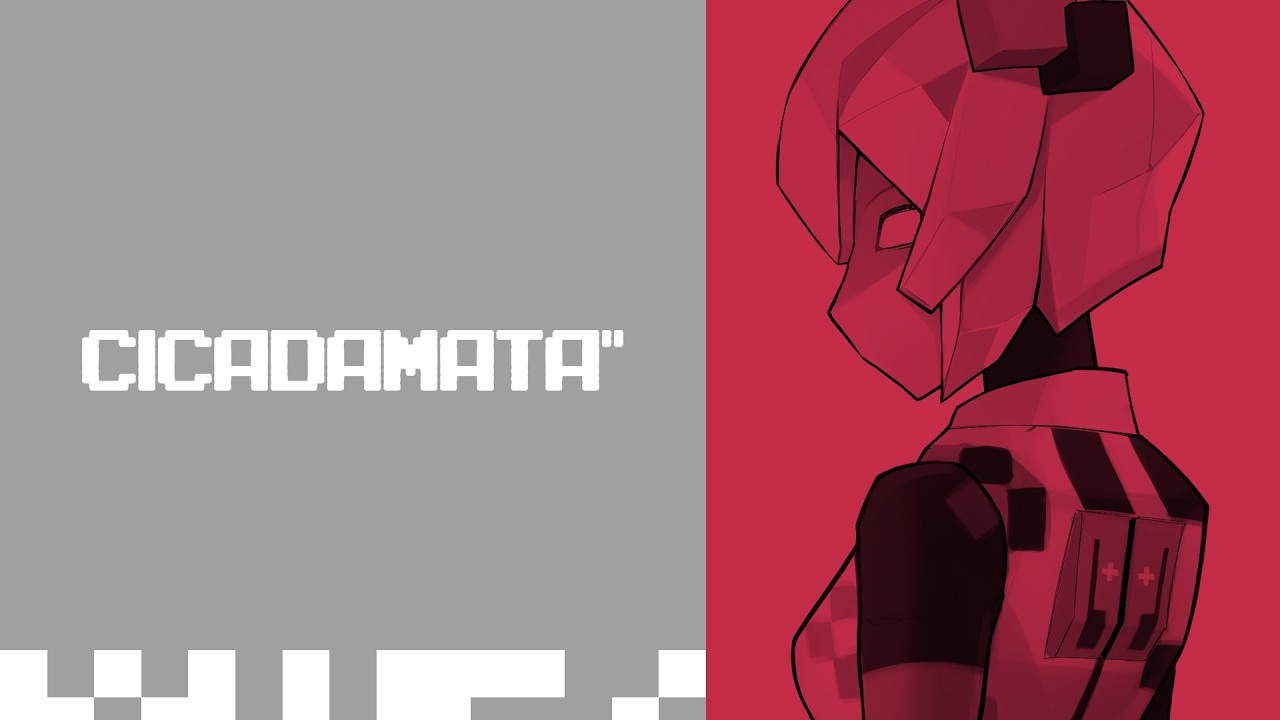
CICADAMATA turns shooting, enemies, and level geometry into one continuous movement problem, then has the good sense to end before that idea wears itself thin.
REVIEW
Ninety minutes was all it took me to finish CICADAMATA. Normally, that would be a harsh criticism of a game. Here, I think it’s one of the smartest things CICADAMATA does. It takes one very satisfying idea, builds the entire game around it, and then has the good sense to end before that idea wears itself thin.
At first, I thought I was getting a stylish, Marathon-inspired movement shooter. Instead, I got something closer to Neon White. The levels in CICADAMATA are less combat arenas and more obstacle courses to route through. Shooting, enemies, and level geometry all become parts of one continuous movement problem. And once that clicks, CICADAMATA becomes pure flow.
THE MARATHON INFLUENCE GOT ME IN THE DOOR
The Marathon influence is honestly what first got me through the door, along with the ten-dollar price tag.
There is a very obvious similarity between the two games, and CICADAMATA’s visual style is absolutely going to be polarizing for some people. The environments are stark and geometric, built around bold colors and a strange sci-fi presentation. That is an aesthetic I already love, so this was an easy buy for me.
But the art style is not why I finished the game satisfied. The real hook is the way CICADAMATA moves. It may look like Marathon, but it certainly does not play like Marathon. And once I understood what the game actually wanted from me, everything clicked.
THESE AREN’T ARENAS. THEY’RE ROUTES.
Early on, the shooting feels competent, but not particularly extraordinary by itself. Eventually, though, you start to understand how shooting enemies interacts with your movement. Enemies stop being things you kill for score and start becoming movement tools you plan your route around.
The question changes from, “How do I clear this room?” to, “How do I move through this room cleanly?” Enemy placement, elevation, geometry, momentum, and where you want to land next all become part of how you read the level. That is when the flow state really starts to kick in.
There is something immensely satisfying about chaining an entire level together instead of killing everything around you and then plodding along to the next area. CICADAMATA is not really asking you to conquer these spaces. It is asking you to understand how to move through them efficiently.
THE GAME DOESN’T EXPLAIN ITS BEST IDEA VERY WELL
Unfortunately, CICADAMATA does not explain this idea particularly well. The shooting-to-movement relationship is incredibly important, but the game never clearly teaches you how it works. I had to discover why shooting mattered to traversal almost by accident through experimentation and the occasional loading-screen hint.
Once you understand it, the entire game becomes much better. But that lack of signposting runs the risk of hiding CICADAMATA’s strongest idea from players who do not naturally experiment. The game really could have used a stronger tutorial, early levels built specifically around demonstrating how different enemies interact with movement, and clearer visual feedback connecting kills to traversal potential.
The mechanic also does not evolve very much once you understand it. From that point forward, the game mostly asks you to become more fluent with the same vocabulary rather than introducing meaningful new wrinkles. You get better at reading routes and chaining movement together, but the underlying idea remains largely unchanged.
I would not say CICADAMATA is bad because it is ultimately pretty shallow. But it is definitely limited. And I think the game knows that.
CICADAMATA KNOWS WHEN TO END
Knowing when to end is something a lot of games struggle with. A 90-minute runtime is definitely going to be something some players balk at, regardless of the ten-dollar price tag. But I never felt cheated. Instead, I felt like this format simply could not have supported much more runtime without significantly expanding CICADAMATA both mechanically and systemically.
Another three or four hours of this exact same game would have exposed its limitations pretty hard and ultimately detracted from the experience. Instead, CICADAMATA ends while the loop is still fun. If the developers wanted to make this a substantially longer game, they would have needed to meaningfully expand the movement vocabulary, enemy interactions, level design, or progression systems.
Without that expansion, the alternative is padding: forced replays, tedious escalation, artificial friction, or progression systems that exist mostly to stretch the runtime. And none of that would make CICADAMATA better. The game ends at almost exactly the point where it would need to become a much bigger game.
SCORE CHASING IS THERE—BUT IT WASN’T FOR ME
There is replay value here, though. CICADAMATA has rankings and leaderboards for the true speedrun sickos out there, so if you are the kind of player who wants to optimize every route and shave seconds off your time, the game absolutely gives you somewhere to go after the credits roll.
Personally, I am not a score chaser. I never felt compelled to rerun stages just to execute them more cleanly, and the game never offered any additional reward that mattered enough to me to change that. For me, finishing a route, enjoying the flow of it, and then moving on to the next challenge was enough.
I think you would have to fall pretty hard in love with this movement system to spend hours chasing high scores and competing on the leaderboards. And if you do, there is clearly a lot more game here than the 90 minutes it took me to finish the campaign.
I HAVE NO FUCKING IDEA WHAT THE STORY WAS ABOUT
I also have no fucking clue what this story was about. It was never central to my experience, and I finished the game with far more questions than answers. There is obviously lore here. You can find terminals throughout the levels, there are named characters, specific terminology, and repeated ideas around identity, memory, transformation, and other esoteric concepts.
But after finishing the game, I still cannot meaningfully explain what was happening, why it was happening, or what the ending was actually supposed to mean. The ending is especially puzzling because it suddenly introduces explicit personal drama and named characters without the rest of the game giving you enough context to understand why any of it matters.
The atmosphere is absolutely a vibe, but there is almost no narrative clarity. I can enjoy mystery. I can enjoy cryptic storytelling. But there is a point where withholding information stops creating intrigue and starts becoming poor communication, and CICADAMATA crossed that line for me.
VERDICT
CICADAMATA is not incredibly deep. It does not evolve very much, its story is communicated so poorly that I still have no idea what actually happened, and its best mechanic could absolutely be taught better. But once CICADAMATA clicks, it clicks hard. For those 90 minutes, it feels fantastic.
The art direction is great, the movement feels incredible, and the game has the good sense to end before its limitations start becoming annoyances. CICADAMATA knows exactly what it does well, gives you enough time to enjoy it, and then gets the hell out of the way. That is why I am giving CICADAMATA an 8/10.
8/10
Reviewed by VG Frogman
Platform: PC
Published: 10/26/2026