
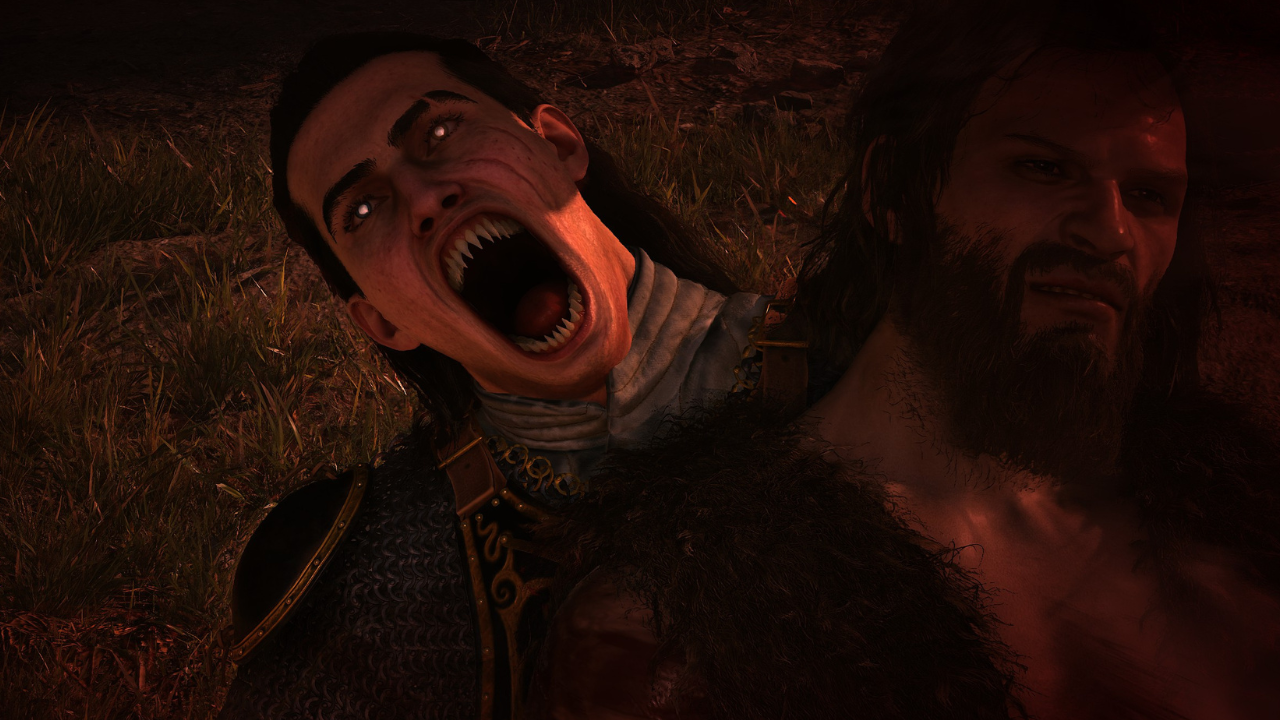
Dawnwalker’s world, characters, and consequential choices are exceptional. Its timer, combat, and progression introduce promising ideas, then stop developing them before they can sustain the whole campaign.
SO CLOSE TO GREATNESS
The Blood of the Dawnwalker is a very good action RPG and the best vampire game I have played since the original Vampire: The Masquerade – Bloodlines. Its world hooked me immediately and never really let go.
The characters are excellent. Several belong in the same conversation as Geralt, Triss, Yennefer, and the other memorable figures of western RPGs. Choices have consequences in both obvious and surprising ways.
Mechanically, it introduces interesting ideas intended to evolve the Witcher 3 formula. Almost every one stops developing before fully delivering on its premise.
The result is a great RPG wrapped around a decent action game that becomes increasingly repetitive the longer you play.
THIRTY DAYS, TWO VERSIONS OF COEN
Coen has 30 days to rescue his family from the vampire lord Brencis and his lieutenants. Like Geralt, he is a predefined protagonist: young, inexperienced, generally decent, and heroic.
The player determines how much he compromises himself. You can feed on innocents, take the powers of the lieutenants, and behave like an evil bloodsucking asshole. The game respects those decisions and applies consequences.
Day and night change your toolkit. During the day, swordplay and witchcraft are available; at night, swordplay and vampire abilities take over. Separate equipment sets let you build around each version of Coen.
Major actions consume segments of the daily clock. The intended fantasy is to become powerful enough to confront Brencis while choosing carefully how to spend your limited time and how much humanity you are willing to surrender.
THE ROLE-PLAYING PREMISE DELIVERS
The opening establishes Coen’s family, the stakes, the world, and who he was before becoming a vampire. Characters behave believably within that world and feel like real people.
Choices produce immediate consequences and longer-term outcomes you cannot always anticipate. An apparently obvious moral decision can come back to bite you.
Coen has enough personal identity to feel like a character without eliminating your role-playing. Because he begins young and inexperienced, you have meaningful control over the person he becomes.
His relationship with the witch Anca is particularly well written. Chemistry and sexual tension develop naturally instead of feeling like filling a romance meter. The romance is optional and offers no tangible reward beyond role-playing.
Their experiences together change the relationship, and its resolution felt earned. The narrative and character work are exceptional enough to belong in masterpiece territory.
THE TIMER IS MORE URGENT IN THEORY THAN IN PRACTICE
Major quests, minor quests, and even spending talent points consume time. Some quests fail if you miss their deadlines. Initially, this sounds like a serious opportunity-cost system.
My playthrough lasted roughly 25 hours. I finished at level 32 out of 50, with 12 full days remaining, nearly all major side quests completed, and about half the minor content done. The final mission and boss gave me no significant trouble.
Twelve days means another 12 day cycles and 12 night cycles of outposts, monster lairs, and other activities that could have supplied more levels. The clock was generous enough that I rarely had to make difficult strategic tradeoffs.
The world does respect sequence-breaking. I accidentally encountered Xanthe early, killed her, and bypassed her normal regional progression. That was cool, but the generous timer meant the shortcut offered little practical advantage. Following the regular route would still have left plenty of time.
Worse, the timer reverses its function late in the game. A quest needs nighttime, it is currently day, and you have no meaningful daytime quest left. Suddenly, you are hunting filler activities to advance the clock.
The question stops being “Can I afford to spend this time?” and becomes “What bullshit can I do until sunset?”
GREAT FIRST IMPRESSIONS, SHALLOW MASTERY
The directional melee initially feels excellent. It is readable, tactile, and less clunky than Kingdom Come’s implementation. Prompts are clear and perfect-guard timing is generous. Early on, I kept thinking this was how Witcher 4 should handle swordplay.
By around hour 18, I had effectively solved the system. Attack, exploit perfect parries, attack again, and dump cooldowns. The game introduces little mechanical escalation after you learn its small set of enemy behaviors.
Visual variety disguises that limitation briefly. Different dogs share attacks. A guard becomes a bandit or undead warrior with familiar animations and familiar counters. An apparently new enemy turns out to be the same sword-wielding problem in another skin.
Once that becomes obvious, combat increasingly feels like a chore.
MORE ENEMIES MOSTLY MEANS MORE INTERFACE FRICTION
One-on-one fights become very easy, so the game adds bodies to create difficulty. Its camera and lock-on system are poorly suited to handling those groups.
Attacks arrive from offscreen, leaving you to guess the block direction. Lock-on can change targets while you are positioning Coen. Nearby walls, trees, rocks, and other geometry can disrupt the camera until it becomes difficult to see the fight.
Multiple enemy types do not reliably produce new priorities or demand different tactics, because those enemies remain mechanically simple.
Adding bodies rarely creates more interesting decisions. It creates more trouble fighting the interface.
PROGRESSION DISCOURAGES EXPERIMENTATION
The obvious build identities are swordsman, witchcraft, and vampire. I focused on swordsman and vampire and never invested in witchcraft.
I wanted to experiment, but talent points cost time and there is no respec. Swordplay felt like a necessary investment under level scaling, and its useful passives also supported the vampire tree. Splitting further into witchcraft seemed likely to weaken that coherent build.
That does not prove other builds are unviable. It shows how the progression system discouraged me from trying them.
Vampire Coen also feels substantially stronger and more enjoyable than daytime Coen. The claws are powerful, benefit from more passives, and accompany more satisfying traversal. Daytime increasingly becomes something to tolerate until you can use the better toolkit again.
Level scaling further weakens the excitement of gear progression. A legendary weapon felt great to acquire until enemies still took approximately the same time to kill. Improving swordsman often felt like keeping pace rather than becoming powerful.
I finished with substantial progression remaining in both trees, without needing their ultimate abilities. By then, the repeated combat made rolling credits more appealing than exploring the rest of the build.
A DENSER WORLD WITH FAMILIAR ACTIVITIES
The world is smaller and denser than Witcher 3 in traversal terms, but its activities are familiar: bandit camps, guard outposts, monster caves, combat challenges, and repeated regional objectives.
Structurally, it reminded me more of Far Cry 5. Regional activities lead toward the local boss, although you can choose when to confront them rather than being forcibly pulled into progression.
Sequence-breaking keeps that structure from being completely rigid. Once a regional boss is dead, however, many remaining activities become little more than sources of experience.
The opening learning curve did not turn into sustained pressure on the normal, developer-recommended difficulty. Once I internalized combat and gained some talents, neither the clock nor ordinary encounters made me stop and think very often.
I did not test harder difficulties. The weakness I am describing is the lack of evolving problems on the difficulty I actually played.
PERFORMANCE WAS GOOD; SAVING WAS UNRELIABLE
I played most of the game at 4K on the High preset, capped at 60 FPS with FSR 4 Balanced. Later, 4K Ultra with FSR 4 Quality gave me roughly 45–60 FPS outdoors and often a stable 60 indoors.
My SCUF controller had unreliable thumbstick and running inputs, which pushed me to a DualSense. PlayStation button prompts were initially missing, although they were patched in quickly.
Autosaving was the more serious issue. I lost a full hour because an expected save never triggered. Another autosave happened on a death screen and repeatedly reloaded into death; manual saves kept that from becoming a much bigger problem.
Those incidents trained me to quicksave constantly. There was also one Unreal Engine 5 crash. Overall, performance was reasonably good in my playthrough, but the saving and input issues still mattered.
VERDICT
Dawnwalker succeeds at worldbuilding, character development, consequential choices, and the vampire fantasy. Its first 18 hours were a joy. By around hour 20, I was ready for it to end, and the characters and narrative carried me across the finish line.
The timer rarely develops real pressure, combat stops evolving, enemy variety is thin, group fights expose camera problems, progression discourages experimentation, and the open-world activities become repetitive.
There are the bones of an exceptional game here. I do not think it needs radically different systems. It needs to trust its existing ideas enough to develop and push them further.
The narrative follows its ambitions through. The gameplay repeatedly stops short.
8/10
Reviewed by VG Frogman
Platform: PC
Publication date: 10/10/2026